The Heritage Foundation: The Birth Dearth
How the Heritage Foundation Frames Fertility, Family, and the Future
“We make no apology for wanting to persuade more young Americans to marry, own homes, raise the next generation, and find deep fulfillment in family life.”
The Heritage Foundation (the Foundation) treats the declining birth rate in America as a moral failure of the people — a signal of cultural decay rather than economic strain. From their perspective, the decline “metastasized” in the 1960s, leading to “broken homes and often-broken children that continues today.”
It is not incidental that they reference the 1960s — a decade marked by civil rights expansion, the loosening of rigid gender norms, expanded workforce participation for women, and broader cultural liberalization. To frame that era as the origin of social breakdown is not a neutral historical observation; it is a value judgment about which freedoms were destabilizing.
“The Heritage Foundation is proud of its position on what a family should look like. The natural family is the cell of the social body, and no body can survive the death and decay of its cells.”
The Foundation has long asserted that marriage is the union between one man and one woman, and that the nuclear family is the optimal structure for social health.
But this definition excludes blended families, same-sex couples, adoptive families, children born through surrogacy, and multigenerational households. These arrangements are not fringe realities — they are woven into the contemporary American landscape. When one model is elevated as socially superior, others are implicitly positioned as deficient.
“For the country’s population to replace itself and flourish across generations, a great many citizens must choose to marry, and as a matter of mathematics, couples must on average have at least two children.”
The Heritage Foundation uses mathematics to describe replacement rates, but it does not answer questions of consent, health, capacity, or desire. It doesn’t account for economic instability, trauma, pregnancy complications, infertility, or the systemic racism deeply woven into our systems. Reducing demographics to arithmetic risks transforming reproduction into obligation.
Their framing here is deliberate. They present childbirth as both a biological and moral obligation, shifting the conversation away from the causes of the declining birthrates: unaffordable healthcare, high childcare costs, student debt, and rising home prices. By doing this, the responsibility shifts from institutions to individuals. Then, the issue isn’t the cost of living, or the instability of employment, it’s the choices of the people themselves — their values, their priorities, and their willingness to conform to the social idea of marriage.
It’s important to note the absence of a proposed policy. The political force calling for “natural families” is the same one that frequently opposes expanding access to healthcare, childcare, paid family leave, and wage equality — policies empirically associated with family stability and improved child wellbeing. So the question becomes: is the goal family flourishing, or cultural conformity?
When Policy Becomes Prescription
“As a matter of public policy, however, policymakers should not endorse technocratic fixes to the birth dearth that conflict with human nature or ignore or bypass the known sources of human flourishing. First among these sources are the institutions of marriage and family.”
When the Foundation warns against “technocratic fixes” that conflict with “human nature,” it is making two assumptions at once:
That human nature is fixed and knowable.
That its fullest expression is heterosexual marriage and biological parenthood.
If the problem is cultural decay, the solution is moral restoration. If the issue is “human flourishing,” the prescription becomes marriage, childbearing, and clearly defined gender roles. Structural supports are seen not as enabling families, but as distracting from the “real” solution: returning to a traditional family order.
In simple terms, the Foundation doesn’t believe we should address declining birth rates with technocratic measures such as paid leave, childcare support, healthcare access, or structural reforms. Instead, they’re subtly telling us that women should return to their traditional roles — get married, have children, make a home.
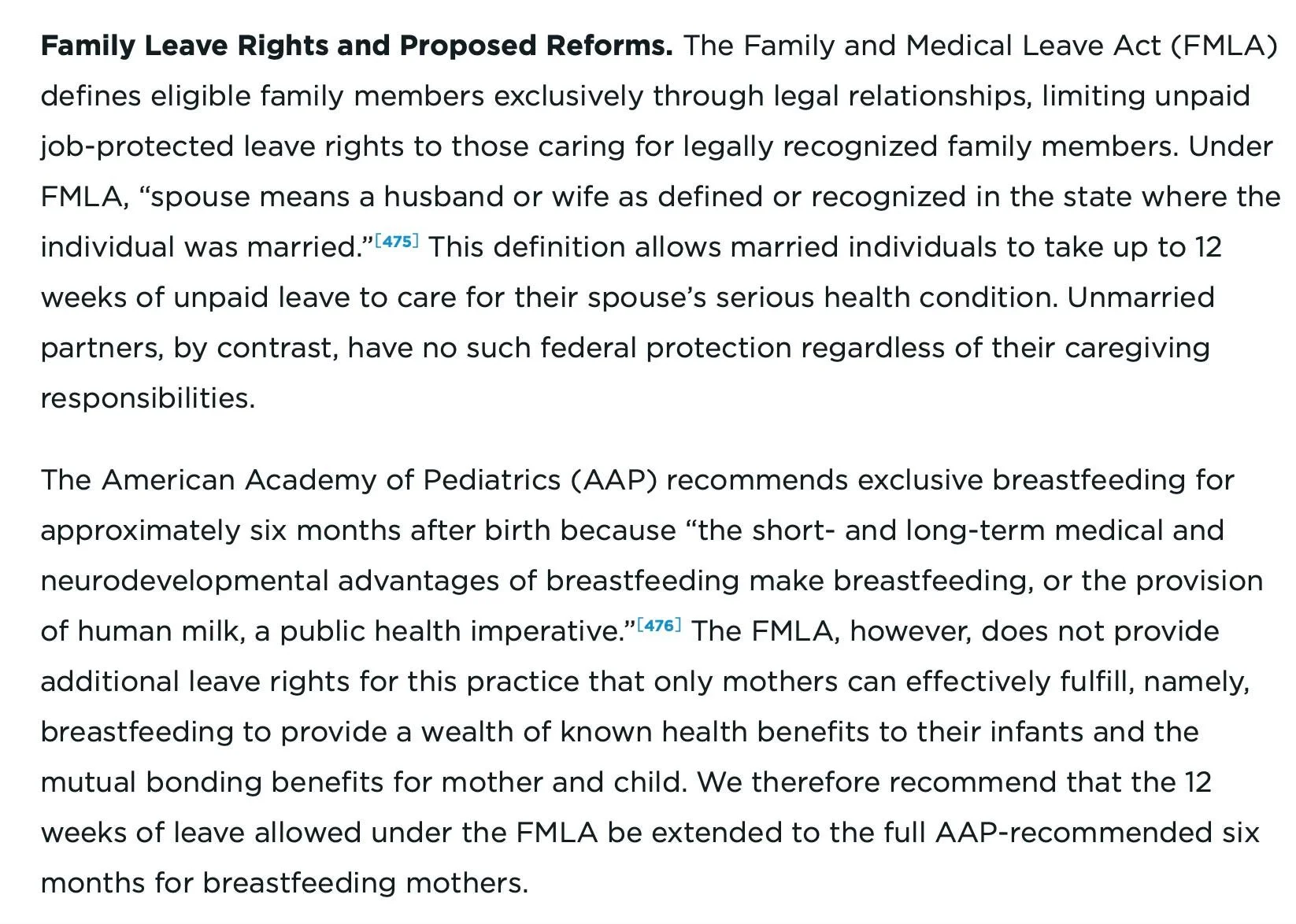
If marriage and family are the “first sources” of flourishing, what makes those institutions stable in modern society? Research consistently shows that economic security, healthcare access, affordable housing, and work-life balance strengthen family outcomes. In other words, what the Foundation calls “technocratic” may in fact be foundational.
There is also an unspoken gender dimension. Calls to restore family-centered flourishing often translate into expectations about women’s labor — both paid and unpaid. When technocratic supports are rejected, caregiving responsibilities do not disappear; they shift back into the private sphere, disproportionately onto women.
And then there is the word “endorse.” Policymakers are cautioned not merely against overreliance on structural reforms, but against legitimizing them at all. That language signals a deeper philosophical divide: Is the role of government to remove material barriers so individuals can form families if they choose — or to reinforce a particular model of family as socially superior?
The difference is subtle but consequential.
One approach broadens options. The other narrows them.
Ultimately, this is not simply a debate about birth rates. It is a debate over whether demographic trends should be addressed through economic support and personal autonomy — or through cultural realignment toward a defined vision of marriage and family.
S.3627 — Pregnant Students’ Rights Act
Ideology does not remain abstract. It materializes in policy.
Consider S.3627:
“This bill requires each institution of higher education (IHE) that participates in federal student aid programs to provide certain information to prospective and enrolled students on the rights and resources for pregnant students to carry a baby to term or students who may become pregnant while enrolled at the IHE to carry a baby to term. In particular, this required information must include a list of community and on-campus resources that exist to help a pregnant student in carrying the baby to term and caring for the baby after birth, information about the accommodations available to help a pregnant student carry the baby to term and parent the baby after birth, and information on how to file a discrimination complaint related to the student’s determination to carry a baby to term” (S.3627)
The emphasis is clear: carry a pregnancy to term. The Act requires colleges receiving federal funding to provide information about resources to support continuing a pregnancy, childcare accommodations, healthcare options, and anti-discrimination protections specifically tied to that decision. On its face, this appears supportive. Title IX already prohibits pregnancy discrimination, and ensuring students understand their rights is important. But the language is directional. The bill does not require institutions to provide comparable information about contraception access, emergency contraception, abortion services, miscarriage management, or broader reproductive healthcare counseling.
Support is not inherently problematic. The question is whether institutional messaging is neutral — or whether it privileges one reproductive outcome over others. That distinction matters, particularly in states where access to abortion or comprehensive reproductive healthcare is already limited. When federally funded institutions are required to distribute information specifically related to carrying a pregnancy to term — and are not required to present the full spectrum of options — the policy emphasis becomes evident.
This approach aligns with broader pronatalist rhetoric that frames childbirth and traditional family formation as civic goods. As the Heritage Foundation has stated, “We make no apology for wanting to persuade more young Americans to marry… raise the next generation…” When viewed alongside that philosophy, S.3627 appears less like a neutral information measure and more like part of a policy orientation that treats childbirth as the socially preferred outcome.
The debate, then, is not whether pregnant students deserve support. They do. The debate is whether public policy should ensure comprehensive, neutral information or guide students toward a particular vision of family formation.
Motherhood, Managed
“The decline of the American family — which began slowly in the first half of the 20th century — metastasized in the 1960s, leading to an epidemic of broken homes and often-broken children that continues today.”
The Foundation puts forward rhetoric that does more than describe demographic change; it medicalizes it. Words like “metastasized” and “epidemic” frame shifts in family structure as disease — something invasive, spreading, pathological. The implication is not simply that birth rates have declined, but that deviations from a particular family model are socially corrosive.
The Foundation’s position suggests that the concern is not simply increasing birth rates, but increasing births within a specific structure: heterosexual, married, biologically connected households. Their opposition to commercial surrogacy reinforces this. Even technological solutions that could increase births are rejected if they disrupt what they define as the “natural” maternal bond.
As they write:
“Surrogacy, whether achieved through artificial means or not, always intentionally deprives a child of the birth mother who carries and nurtures the child for nine months, and who ultimately bears the child…What if, in 2045, the U.S. can build automated factories with artificial wombs that can gestate human babies from the moment of fertilization until they are full term? This would reduce the opportunity costs of pregnancy, especially for women with high-income potential: No morning sickness, no doctor visits, no pregnancy-related sick days away from work, no risk of gestational diabetes and c-sections, and so on.”
Here, the concern is not simply population replacement; it is the reconfiguration of motherhood itself. The hypothetical scenario of artificial wombs is presented not as innovation, but as dystopia — because it separates gestation from traditional female roles and biological attachment.
The tension is revealing: fertility technology that reduces physical burden or career tradeoffs is framed as destabilizing rather than empowering.
If fertility technology reduces the “opportunity costs” of pregnancy — allowing women to maintain careers without physical burden — that is portrayed as destabilizing rather than liberating. The anxiety is not demographic decline alone, but the erosion of gendered expectations embedded in traditional family life.
In this view, family is not simply a private arrangement. It is a moral institution that must remain biologically and structurally intact to preserve social order.
Birth as Civic Duty
One of the core principles embedded in the Foundation’s conception of the “traditional family” is not simply religious conviction, but a fusion of theology and civic identity. In its effort to “save the American family,” the Foundation draws from Christian moral anthropology, particularly evangelical Protestant thought. Marriage is framed as a covenantal union between one man and one woman. Motherhood is treated not merely as a personal choice, but as a natural and morally significant vocation. The family is positioned as a pre-political institution — existing prior to the state — yet simultaneously described as essential to the survival of the nation.
This framing moves beyond private faith. It connects family structure to national continuity. Birth rates are discussed in terms of replacement, generational flourishing, and cultural preservation. Demographic decline is not simply a statistical trend; it becomes a civilizational warning.
This fusion of religion and national identity is not unique.
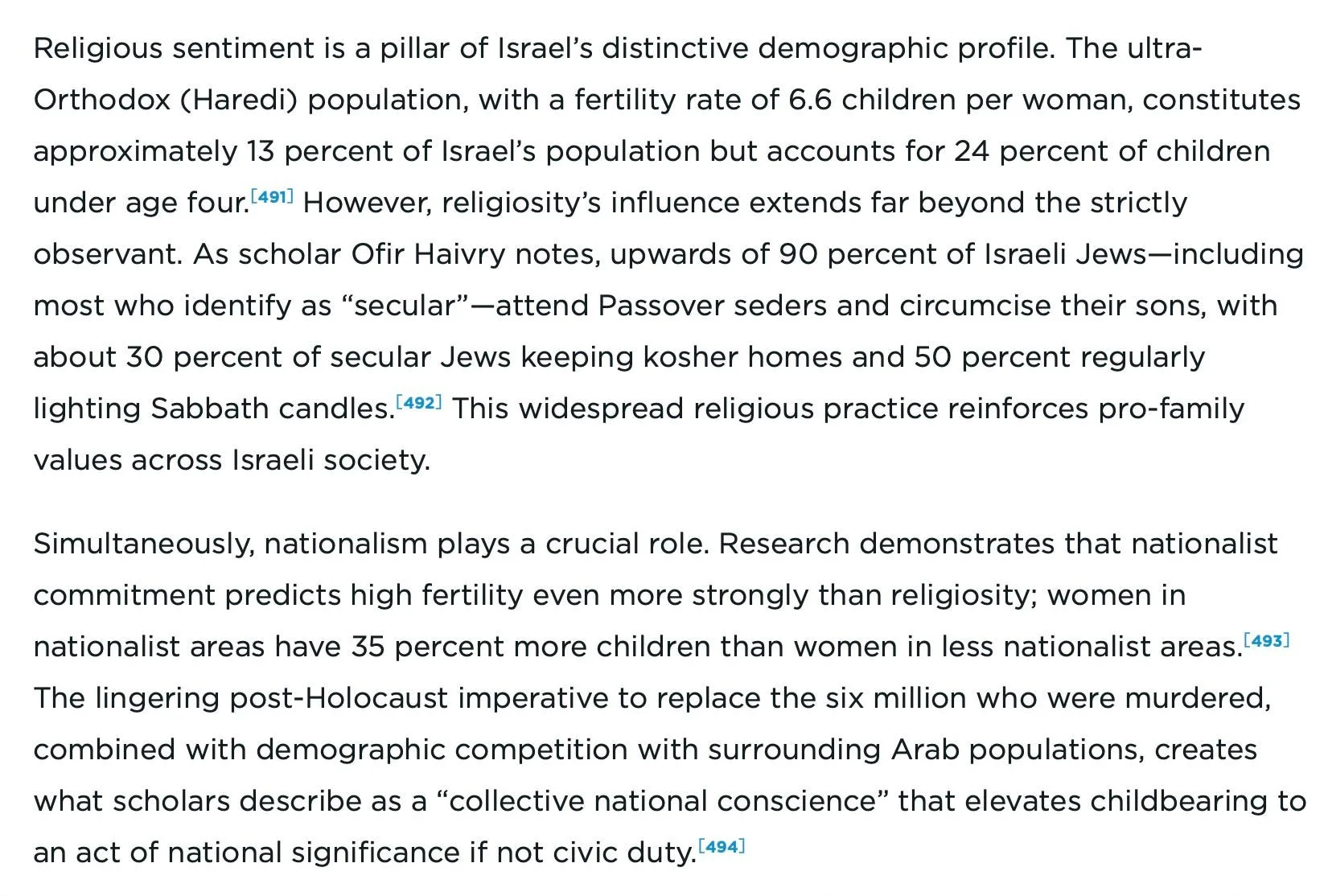
As the excerpt above illustrates, religiosity and nationalism can combine to elevate childbearing into an act of civic significance. In that framework, fertility is not merely a private decision — it becomes part of a collective national project. Childbearing is cast not just as family formation, but as participation in historical continuity.
The parallels are instructive. When demographic trends are framed as existential threats — whether due to cultural change, population decline, or civilizational anxiety — reproduction shifts from personal choice to public duty. The concern becomes not simply that fewer children are being born, but that they are not being born within the “right” moral and structural framework.
This helps explain the Foundation’s opposition to surrogacy and certain reproductive technologies. Even technological solutions that might increase birth rates are rejected if they disrupt what is defined as the natural maternal bond. As they write:
“Surrogacy… always intentionally deprives a child of the birth mother… What if, in 2045, the U.S. can build automated factories with artificial wombs…”
The anxiety here is not population replacement alone. It is the reconfiguration of motherhood itself. Artificial wombs are presented not as innovation, but as dystopia — because they separate gestation from traditional female roles and biological attachment.
According to this perspective, family isn’t simply a private arrangement; it’s a moral institution structured to remain biologically and culturally intact — all in the name of preserving social order.
The debate over the “birth dearth” is not simply about numbers. It is about narrative. When declining fertility is framed as moral failure rather than structural challenge, policy shifts accordingly.
Support becomes directional.
Choice becomes conditional.
Family becomes doctrine.
No society can function without families, but the question is whether public policy exists to strengthen diverse families in the world as it is — or to discipline them into a singular vision of what they should be.
In the end, the conversation is not only about birth rates. It is about who defines flourishing — and who decides the form it must take.
Source:Saving America by Saving the Family: A Foundation for the Next 250 Years