The Heritage Foundation: "Saving America"
Saving America by Saving the Family: A Foundation for the Next 250 Years
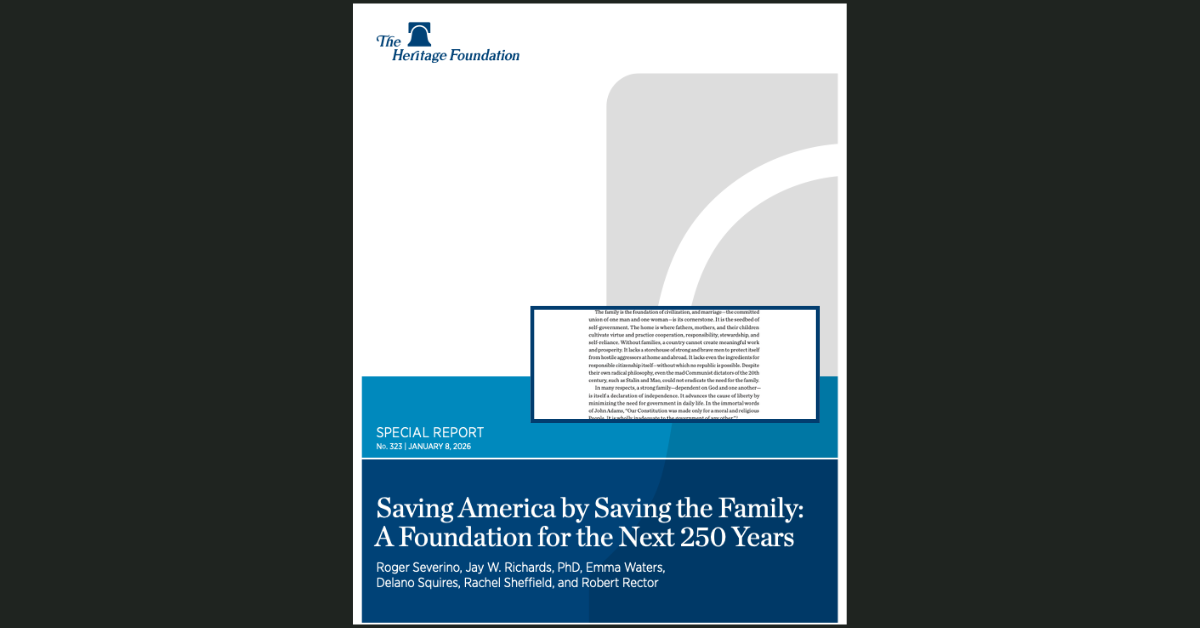
In a report dated January 8, 2026, the conservative policy organization the Heritage Foundation published Saving America by Saving the Family: A Foundation for the Next 250 Years. It details how “American values” have eroded and must be addressed swiftly by the Administration and Congress, and includes a list of recommendations to “restore the American dream and the American family.”
Heritage also described Saving America by Saving the Family as the first in a series of special reports outlining its vision for American family policy. That detail matters. After Project 2025, a new series of policy blueprints from the same institution deserves more attention than ordinary think-tank background material.
The report went mostly unnoticed…until now.
The report proposes three general policy priorities:
1. Stop Punishing Family Formation
“In many respects, a strong family — dependent on God and one another — is itself a declaration of independence.”
The Heritage Foundation argues that the modern welfare system has contributed to the decline in marriage and, silently, the nuclear family (defined throughout the report as a heterosexual married couple with children). Marriage is presented as a primary means of escaping poverty and achieving social stability.
“Marriage is one of the surest paths out of poverty and dependence, and improves the well-being of adults, children, and society.”
The report suggests entitlement funding is disproportionately distributed to unmarried and unemployed households, penalizing men and women who choose to marry.
“Nearly all of the cash, food, and housing programs focus on subsidizing non-married single-parent families, with the greatest benefits aimed at families that do not work.”
The Heritage Foundation calls on Congress and the administration to impose “meaningful” work requirements on able-bodied adults who apply for or receive entitlement funds. They further urge the Legislative and Executive branches to “eliminate all marriage penalties in welfare programs.”
“Additionally, work requirements for the able-bodied must be strengthened and enforced to ensure that children are raised in the best possible circumstances and not trapped in poverty.”
2. Restore the American Dream
The Heritage Foundation argues that high levels of government, federal debt, and taxation have made the “American dream” unattainable. They further argue that its attainability is hindered by the choice not to start a family and by the growing financial crisis (home prices, rising food costs, etc).
“Counterproductive regulations, of course, harm all aspects of civic life. They limit job prospects and make it harder for families to thrive with a single earner. They also stunt the creation of new family businesses and civic institutions as well as the development of new communities. Together, the fiscal and regulatory burdens of government have created an anchor that holds back family formation in America.”
“Accordingly, there must be a whole-of-government approach to elevating and defending the American family in all federal regulations, grants, enforcement, and research. In the first few months of his second term, President Donald Trump systematically dismantled diversity, equity, and inclusion (DEI) policies and practices that had become embedded throughout the federal government. The same zeal and tactics used to implement and then to roll back these policies (because they hurt families) should be used to further policies that actively support families.”
What these recommendations show is that Heritage is thinking much bigger than individual family policies. Heritage is not talking about a single tax credit or a single welfare rule. It is talking about prioritizing marriage and family across the federal government. Taken seriously, Heritage’s “whole-of-government” directive would function as a de facto family-impact test across federal regulations, grants, enforcement, and research — with marriage and the nuclear family positioned as preferred policy outcomes.
Heritage also argues that federal spending, debt, and taxation are making it harder for middle-class families to build stable lives and generational wealth. The report goes even further, linking anxiety, loneliness, and depression to divorce, declining religious participation, unaffordable housing, career pressure, education, and addictive technologies. In Heritage’s framing, restoring the American Dream requires more than economic reform. It requires cultural intervention.
This is about more than Heritage simply preferring marriage. Heritage is proposing that federal economic policy be deliberately structured to make one family model more financially advantageous than others.
That means using tax policy, welfare rules, childcare assistance, investment accounts, federal grants, and regulation to reinforce that preference.
The point is not just to encourage people to marry. It is to make that choice more financially rewarding.
“The most anxious, lonely, and depressed generation in American history became that way through an increase in divorce and decline in religious attendance; careerism; a broken education system; out-of-reach housing costs; and the proliferation of addictive technology, drug abuse, and pornography.”
3. Support marriage and working families.
“Not only must the federal government stop actively punishing marriage; not only must it stop hindering the American Dream; it should also make up for the wholesale damage it has done to the family across generations.”
The Heritage Foundation proposed “three bold federal legislative mechanisms to support married couples with children and offset current and historic marriage penalties,” as well as a “number of state policy ideas throughout.” The three legislative objectives are:
Support marriage with a $2,500 initial deposit into a new investment account.
Apply the “current $17,670 adoption tax credit to married parents for each of their own newborns. This newly proposed credit would be structured to make up for existing marriage penalties in the Earned Income Tax Credit (EITC).”
Congress and the Administration should “make the average value
of credits, programs, and tax benefits currently provided for paid childcare
available for at-home parental child raising.”
“Americans cite for having fewer children than they desire is the cost of raising children. Most of these parents and potential parents would prefer to spend more time raising their children at home if they could afford it, but the federal government largely provides support only for parents who pay others to help to take care of their children.”
It is important to separate what this report explicitly proposes from what its governing framework could enable. The report does not, by itself, contain every policy outcome discussed below. The concern is that once marriage and Heritage’s preferred family structure become organizing principles across federal policy, those principles could shape decisions far beyond the specific tax, welfare, and childcare proposals outlined here.
What could some of the implications be if this framework were implemented?
• A de facto federal “family-impact test”: Heritage’s “whole-of-government” framework could make support for its preferred family model a consideration in federal grants, regulations, enforcement, and research.
• Greater federal pressure on reproductive autonomy: The report does not itself impose a federal abortion or contraception ban, but this governing framework could reinforce broader Heritage efforts involving abortion, contraception, privacy, and reproductive policy.
• Further challenges to LGBTQ+ legal recognition and family rights: The report does not itself abolish same-sex marriage or bar LGBTQ+ people from adoption or foster care. But privileging heterosexual marriage as a federal policy objective could influence future rules involving family recognition, adoption, foster care, religious exemptions, and federal funding.
Who does this target?
• Women
• LGTBQ+
• Single Parents
• Low-income families
• Survivors of Domestic and Sexual Violence
• Religious Minorities
• Immigrants
• People with Disabilities
The Heritage Foundation, the organization behind Project 2025, has poured enormous resources into shaping policy, supporting President Donald Trump, and advancing a broader conservative governing agenda. Its reports are not vague ideological wish lists. They are detailed, organized roadmaps for changing American law, policy, and social norms.
Since his first day in office, the Administration has moved so quickly that it has become difficult to track what is changing, what has already changed, and what is still being proposed. Whether you agree with these goals or not, Saving America by Saving the Family is a blueprint for using federal power to reshape private life, family structure, and cultural norms.
And this is only the first report in a series.
This has been a very brief summary of Saving America by Saving the Family: A Foundation for the Next 250 Years. I’ll keep reading. You should too.
* I use both “entitlement program” and “welfare” in this analysis. The Heritage Foundation favors “welfare” in its report.