Trump Listed the Kennedy Center. He Did Not List the Board of Peace.
Trump's annual financial disclosure lists the Kennedy Center. It does not list the Board of Peace.
Something Doesn't Feel Right | Kimmie Elrod | July 1, 2026
On June 29, 2026 — five months after Donald Trump launched an international reconstruction body he will chair for life, five months after foreign governments began pledging billions of dollars to an unaudited JPMorgan account he controls, five months after the State Department redirected $1.25 billion in congressionally appropriated funds to that body without a single vote — Trump filed his annual financial disclosure with the Office of Government Ethics.
He listed the Kennedy Center.
The Board of Peace does not appear.
The OGE Form 278e is a legal document. Part 1 requires disclosure of all positions held outside the federal government — paid or unpaid — including roles as officer, director, trustee, or employee. The obligation is not ambiguous. The Ethics in Government Act does not carve out exceptions for positions a president finds inconvenient to acknowledge.
Trump's 2026 annual disclosure lists four positions:
CIC Digital LLC — ended January 9, 2025.
CIC Ventures LLC — ended January 9, 2025.
Mar-A-Lago Club, L.L.C. — President, ongoing.
John F. Kennedy Center for the Performing Arts — Chairman, February 2025 to present.
That is the complete list. The Board of Peace — the Trump-chaired international body that has pledged $17 billion to rebuild Gaza, that grants lifetime chairmanship to its founder by executive order, that has accepted hundreds of millions of dollars from foreign governments including the United Arab Emirates and Saudi Arabia — is absent.
Trump was granted a 45-day extension to file this disclosure. He had extra time. He filed it anyway without the Board of Peace on it.
The administration's likely defense writes itself: the Board of Peace is a governmental function. Trump chairs it as President, not as a private individual. No disclosure required.
That argument has a problem.
Executive Order 14375 designated the Board of Peace as a Public International Organization under the International Organizations Immunities Act — a legal classification that defines it as separate from the United States government. The administration made that choice deliberately, to shield the Board of Peace from congressional oversight and domestic legal accountability. An entity cannot simultaneously be a governmental function for disclosure purposes and a legally independent international organization for immunity purposes. The administration argued for independence when independence was useful. The disclosure form suggests it has retreated from that position when accountability becomes inconvenient.
There is a second problem. The Board of Peace accepts payments from foreign governments — $1 billion per permanent seat, according to reporting on the UAE, Saudi Arabia, and Qatar commitments. Whatever legal category the chairmanship occupies, those payments flow to an entity Trump controls for life. The Ethics in Government Act was designed precisely for arrangements like this one.
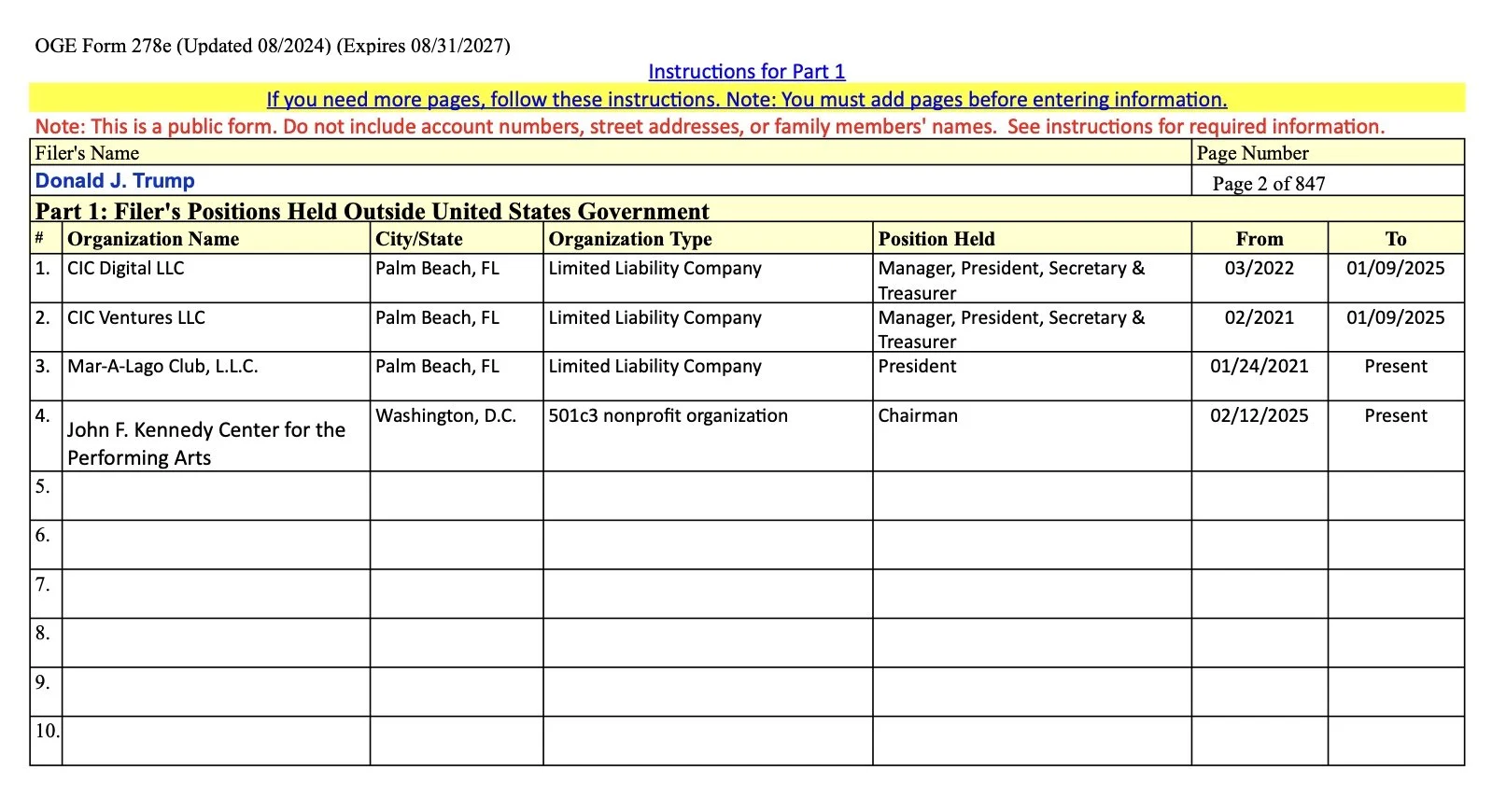
Part 1 of President Trump's OGE Form 278e annual financial disclosure, filed June 29, 2026. The Board of Peace does not appear.
The JPMorgan question is its own separate matter — and the disclosure makes it worse.
Donations to the Board of Peace flow into a JPMorgan Chase account. That account carries no obligation to report its financial position to contributors, board members, or the public. The World Bank fund established alongside the Board of Peace has received zero dollars despite $17 billion in pledges. The money is in JPMorgan. Nobody outside that account structure knows how much is there, where it is going, or what it funds.
Trump's 2026 financial disclosure confirms he holds JPMorgan Chase stock in three separate investment accounts.
He is simultaneously: the lifetime chair of a body whose unaudited donations sit in a JPMorgan account; a plaintiff in a $5 billion personal lawsuit against JPMorgan CEO Jamie Dimon; and a stockholder in JPMorgan Chase across three investment accounts.
These facts appear in his own disclosure. They have not been reported together. They raise questions that the disclosure, by design, does not answer — because the Board of Peace position that would require him to answer them is not on it.
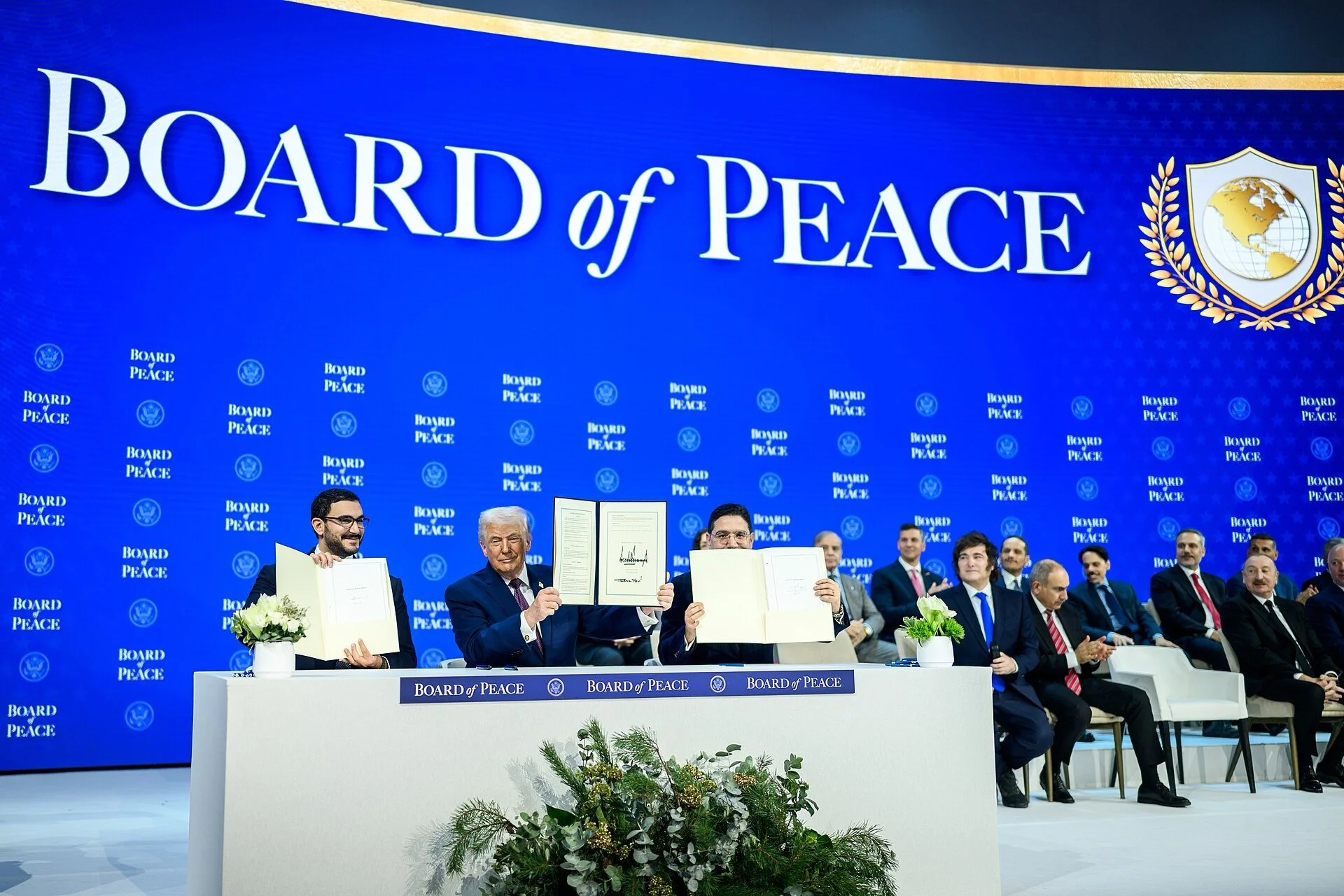
Official White House Photo by Daniel Torok
The State Department has redirected $1.25 billion in funds appropriated by Congress for international disaster relief and peacekeeping to the Board of Peace, without congressional authorization. Senator Mark Kelly confirmed the transfer in April 2026. No vote was taken. No appropriation was sought.
The money moved. The position went undisclosed. The account remains unaudited.
The Board of Peace is not in the Kennedy Center's weight class. It is not a cultural appointment or a ceremonial role. It is an entity with billions of dollars in pledges, active reconstruction contracts being awarded — including a military base in southern Gaza, awarded through Signal communications with no public record — and lifetime leadership vested in a sitting president who owns stock in the bank that holds its money.
That position belongs on a financial disclosure form.
It is not there.
The right-of-reply requests sent in connection with the broader investigation into the Board of Peace and its contractor network — including to legal counsel for Safe Reach Solutions, the armed contractor that operated Gaza checkpoints — went unanswered as of the July 1, 2026 deadline.
The White House press office responded to a request for comment sent July 1, 2026. Spokesperson Anna Kelly said the administration had never engaged in conflicts of interest and that reporters raising such questions were "recycling the same, tired, false narrative that Democrats and the legacy media have been pushing for a decade." The statement did not address the omission of the Board of Peace from Part 1 of the OGE Form 278e — the specific subject of the inquiry. The White House also referred questions to the Trump Organization.
Primary sources for this piece include Trump's OGE Form 278e annual financial disclosure filed June 29, 2026; the ProPublica Trump financial disclosures database; Executive Order 14375; and reporting by the Financial Times, Semafor, and Senator Mark Kelly's April 2026 press release confirming the $1.25 billion State Department transfer.
If this piece is useful to you, please share it.