Venezuela: Two Earthquakes, One Minute Apart
June 27, 2026
At 6:04 PM local time on Wednesday evening, the ground beneath northern Venezuela broke in two places, thirty-nine seconds apart.
A 7.2 magnitude earthquake struck near San Felipe, about 176 miles west of Caracas. Less than a minute later, a 7.5 struck near Yumare — the same fault zone, compounding destruction before the shaking from the first had stopped. One witness described two to three minutes of unrelenting shaking.
Many residents were home. Wednesday was a national holiday — the commemoration of the 1821 Battle of Carabobo, the military victory that secured Venezuela's independence from Spain. Families were inside when the walls began to move.
Buildings collapsed in Caracas. Simón Bolívar International Airport, which serves the capital from the coastal state of La Guaira, sustained severe structural damage and was forced to close. Hospitals activated emergency protocols. Power and internet went down across large parts of the country.
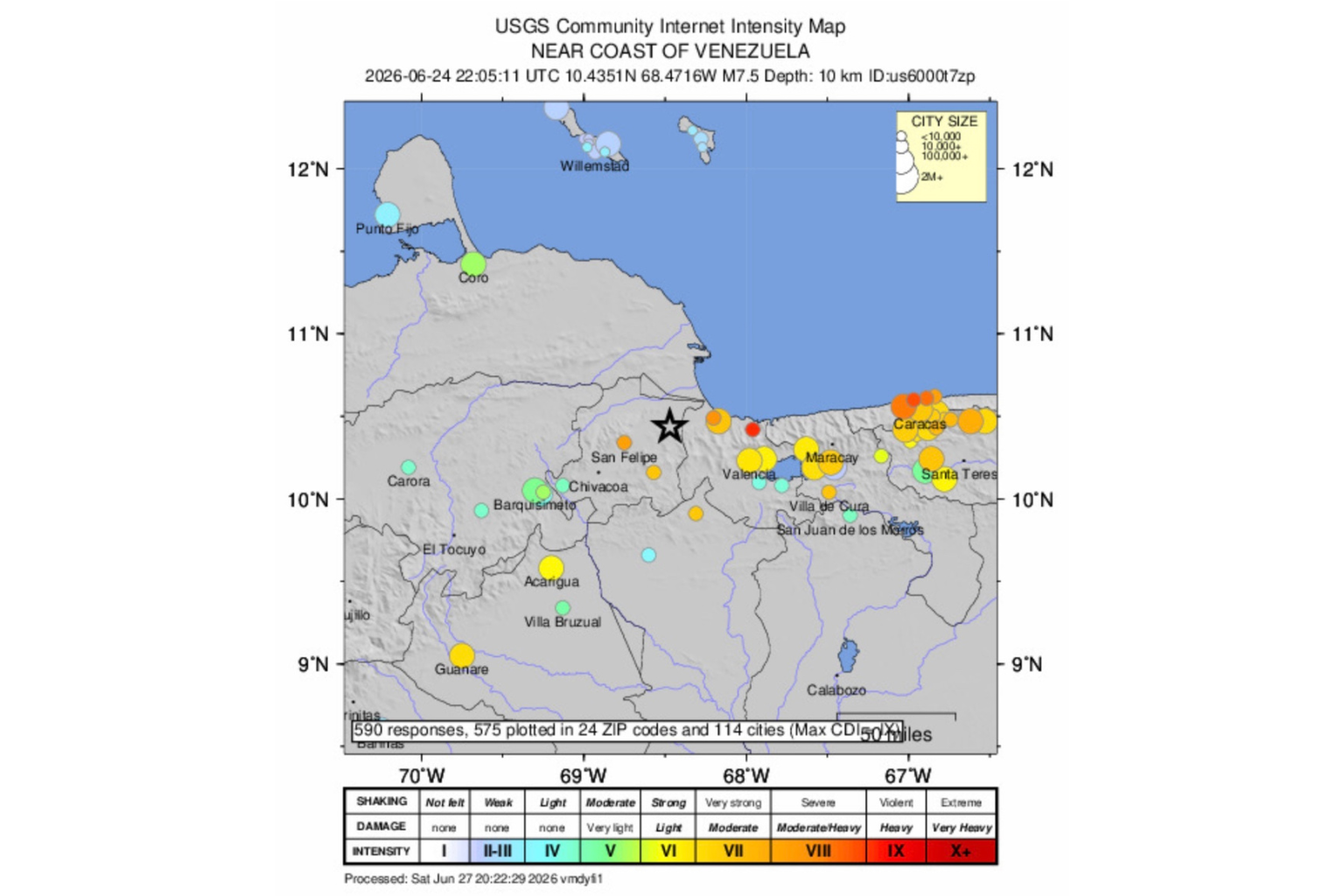
USGS Community Internet Intensity Map showing the M7.5 earthquake near the coast of Venezuela, June 24, 2026. Red and orange zones indicate violent to extreme shaking intensity across Caracas and La Guaira. Public domain.
What we know.
As of Saturday, June 27, at least 1,430 people are confirmed dead. More than 3,200 are injured. At least 172 remain trapped under rubble. More than 3,100 families have been displaced. The dead include nationals from Brazil, China, Spain, Portugal, and Italy. The toll continues to rise as rescue teams reach areas that have been cut off since Wednesday night.
Acting President Delcy Rodríguez declared a state of emergency. La Guaira — the coastal state just north of Caracas — has been declared a disaster zone. The United Nations reports more than 100 buildings collapsed in La Guaira alone. Satellite imagery from Planet Labs shows the waterfront hotel in Macuto reduced to rubble. In the Chacao neighborhood of Caracas, a residential building known as the Petunia collapsed. Neighbors have been standing vigil at the debris removal site since it fell.
U.S. teams have repaired one of the runways at Simón Bolívar Airport, easing one of the most critical bottlenecks for getting rescue personnel and equipment into the country. Across 17 flights, over 1,600 rescuers from more than 30 countries have now arrived. PBS
Aftershocks continue. At least 138 have followed the twin quakes. Seismologists expect more.
Understanding the death toll estimates.
The gap between 1,430 confirmed deaths and the much larger projections circulating in the media requires explanation, because both numbers reflect different truths.
The USGS PAGER system — Prompt Assessment of Global Earthquakes for Response — estimated a 43% probability of deaths between 10,000 and 100,000, and a 22% probability the toll could exceed 100,000. Those are not predictions. They are probability distributions generated automatically by models that combine the quake's magnitude and depth, ground-shaking intensity, population density, and building vulnerability. PAGER does not count bodies. It models exposure.
The 1,430 confirmed deaths represent what rescuers have physically reached and verified. The PAGER range reflects what the model predicts across the entire affected zone — including places no one has reached yet.
The areas with the highest shaking intensity are often rural communities with poor communications infrastructure, even before a disaster. When roads wash out, power fails, and phones go down, no news comes out. Seismologists and disaster researchers have noted a grim inverse signal: if reports from rural areas near an epicenter go silent for days, the situation there is likely very bad. The silence itself is a data point.
Venezuela's communications remain degraded. More than 200 websites in the country are blocked, including local and international news, social media sites, and censorship circumvention tools — a restriction that predates the earthquake and compounds the information blackout now. ABC News
The search and rescue effort.
Miami-Dade Fire Rescue's Florida Task Force 1 — 80 members, including six canine teams, have joined the U.S. relief effort, transported by Air Force C-17 Globemaster aircraft. Fairfax County, Virginia, and Los Angeles County teams were already on the ground. Mobile hospitals are arriving. The U.S. is also working to get Starlink terminals into the country, where connectivity gaps are adding to the agonizing wait for news on missing family members. PBS
Rescue convoys from Mexico, El Salvador, and the Dominican Republic arrived on June 26. Colombia, Spain, Ecuador, Chile, Panama, France, and Switzerland have also deployed teams. The Venezuelan Red Cross — despite damage to its own national headquarters — deployed assessment teams the night of the quakes and has kept its nationwide network of hospitals and clinics active. CNN
Constant aftershocks and a lack of heavy machinery are slowing operations in critical areas, while entire communities continue clearing debris on their own. Some residents in coastal areas are calling for civilian volunteers with pickaxes and shovels. Frustration with the pace of the official response is mounting. Al Jazeera
Who is the silence covering?
The communities closest to the epicenter — rural, under-resourced, with degraded communications before the first tremor hit — have produced the least reporting. That is a structural feature of how disaster information flows, and it is the reason the confirmed death toll and the modeled death toll remain so far apart three days in.
The golden window for finding survivors alive in collapsed structures is narrowing. Every hour that passes without access to the rural zones near San Felipe and Yumare is an hour that won't come back.
An economy already on its knees.
Before the ground moved on Wednesday, nearly 8 million of Venezuela's 28 million people were already in need of humanitarian assistance. The country has spent years under hyperinflation, political crisis, and economic collapse. The earthquakes did not arrive in a vacuum.
Initial forecasts suggest damage could cost as much as 7% of Venezuela's GDP. One economist described reconstruction as a long-term effort requiring significant external financial and technical support — all the more difficult given the country's already-degraded public infrastructure and limited fiscal capacity. CNN
The oil question — answered
Fourteen miles from the epicenter of the 7.5 earthquake sits Yumare, home to some of Venezuela's largest refineries. The silence from that area in the first hours after the quake raised questions. Those questions now have answers.
All major refining operations are confirmed normal. The Paraguaná Refining Center, El Palito, Puerto La Cruz, and the José terminal export hub all reported unaffected operations. Chevron, Eni, and Repsol confirmed their Venezuelan assets sustained no infrastructure damage. The Morón Petrochemical Complex — the country's second-largest petrochemical plant — briefly shut down after a storage tank leak was detected Wednesday night, but restarted Thursday. marketscreener
Six vessels were loaded with Venezuelan crude on June 25. Exports had already surged in recent months following the U.S.-backed removal of Nicolás Maduro in January and the subsequent relaxation of sanctions on state oil producer PDVSA. The infrastructure held. The economic question now is not oil supply — it is whether a country producing just over a million barrels a day has any cushion left to absorb the cost of Wednesday. marketscreener
The geology.
The USGS classified Wednesday's event as a seismic doublet — a phenomenon in which two ruptures occur so close together in time and location that the first has not finished before the second begins. The 7.2 started the shaking. Thirty-nine seconds later, the 7.5 hit — a quake twice as powerful, because of how the magnitude scale works. The combined shaking lasted significantly longer than either event alone would have produced.
Both quakes ruptured along the San Sebastián Fault System, part of the broader plate boundary where the Caribbean Plate meets the South American Plate along Venezuela's northern coast. The 7.5 magnitude earthquake is the largest recorded in Venezuela since 1900. Most structures in the affected region are unreinforced brick masonry and adobe block construction, among the most vulnerable building types to this magnitude of shaking.
Seismologists expect continued aftershocks. There is a 99% probability of at least one magnitude 4 or greater event within the coming week. A magnitude 6 or above remains possible.
The Venezuela, Japan, and California earthquakes — all of which occurred on the same day — are not connected. Large earthquakes thousands of miles apart on separate fault systems do not increase the likelihood of seismic events elsewhere.
Political context.
Rodríguez has been running Venezuela since the U.S.-backed removal of Maduro in January. Secretary of State Marco Rubio confirmed direct contact with her since the earthquakes struck. President Trump posted that he had directed his administration to help, describing the event as massive in scale with a devastating death toll. In addition to $150 million already committed, the administration was preparing an additional nine-figure aid package to be announced imminently. PBS
The geometry of this is worth naming. The United States is sending rescue teams to a country where U.S. special forces conducted a raid six months ago to remove its president. A U.S. oil company is operating at the edge of the disaster zone. The interim government is managing a mass casualty event while navigating a relationship with Washington that is less than six months old.
What we still don't know.
The full casualty count. What is happening in the rural zones near the epicenter that have gone quiet? How many of the 172 still trapped will be found alive? Whether the death toll's trajectory follows the PAGER model or stops short of it.
1,430 is the number confirmed. The number still coming is the one that matters most.
something doesn’t feel right. is independent investigative journalism. If this piece was useful, share it.
